Kyo Jino: Creating Without Limits

Updated: 6 days ago

In Paris, where fashion is constantly reinventing itself, Kyo has built a creative language that resides comfortably inside one category. Self-taught as a Creative Director and Stylist, his work draws from the energy of 1990s and 2000s hip-hop, the visual worlds of anime and manga, Japanese culture and his own African heritage. The result is a universe that feels nostalgic yet distinctly contemporary.
For Kyo, styling has never been simply about putting clothes together. It is about creating a feeling, building a character and, most importantly, changing the way someone sees themselves. Much of his work centres on Black women, whom he deliberately places at the heart of his imagery. Rather than working from a narrow idea of what a fashion model should look like, he celebrates women across different backgrounds, identities, body types and personalities. That philosophy became particularly visible during the earlier stages of his career, when his work developed an unapologetically provocative edge. Latex, vinyl, PVC and other high-impact materials became part of his visual vocabulary, often paired with sensual silhouettes and dramatic styling. Yet beneath the provocative imagery was something more personal: a desire to make the women he worked with feel powerful.
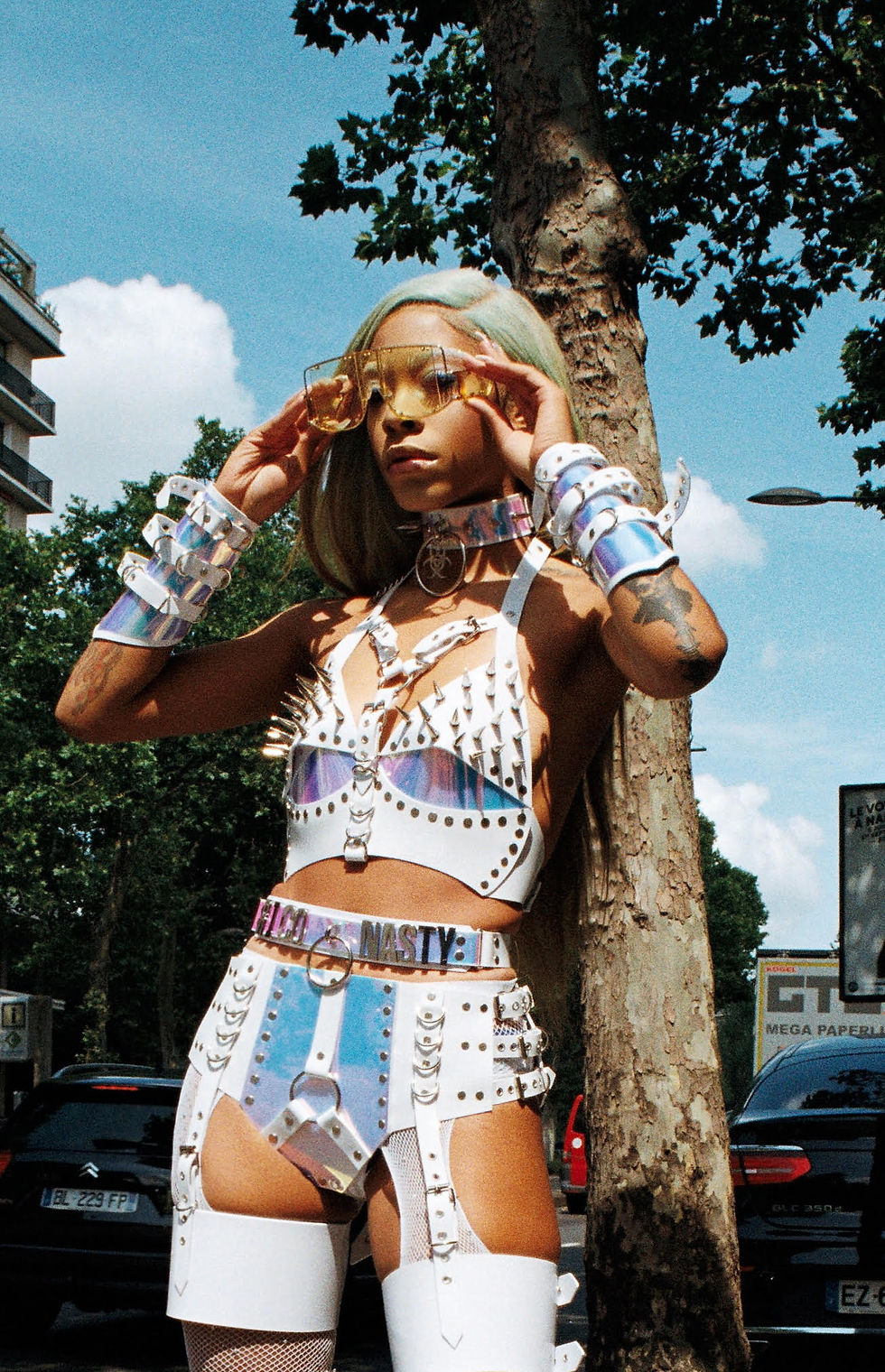
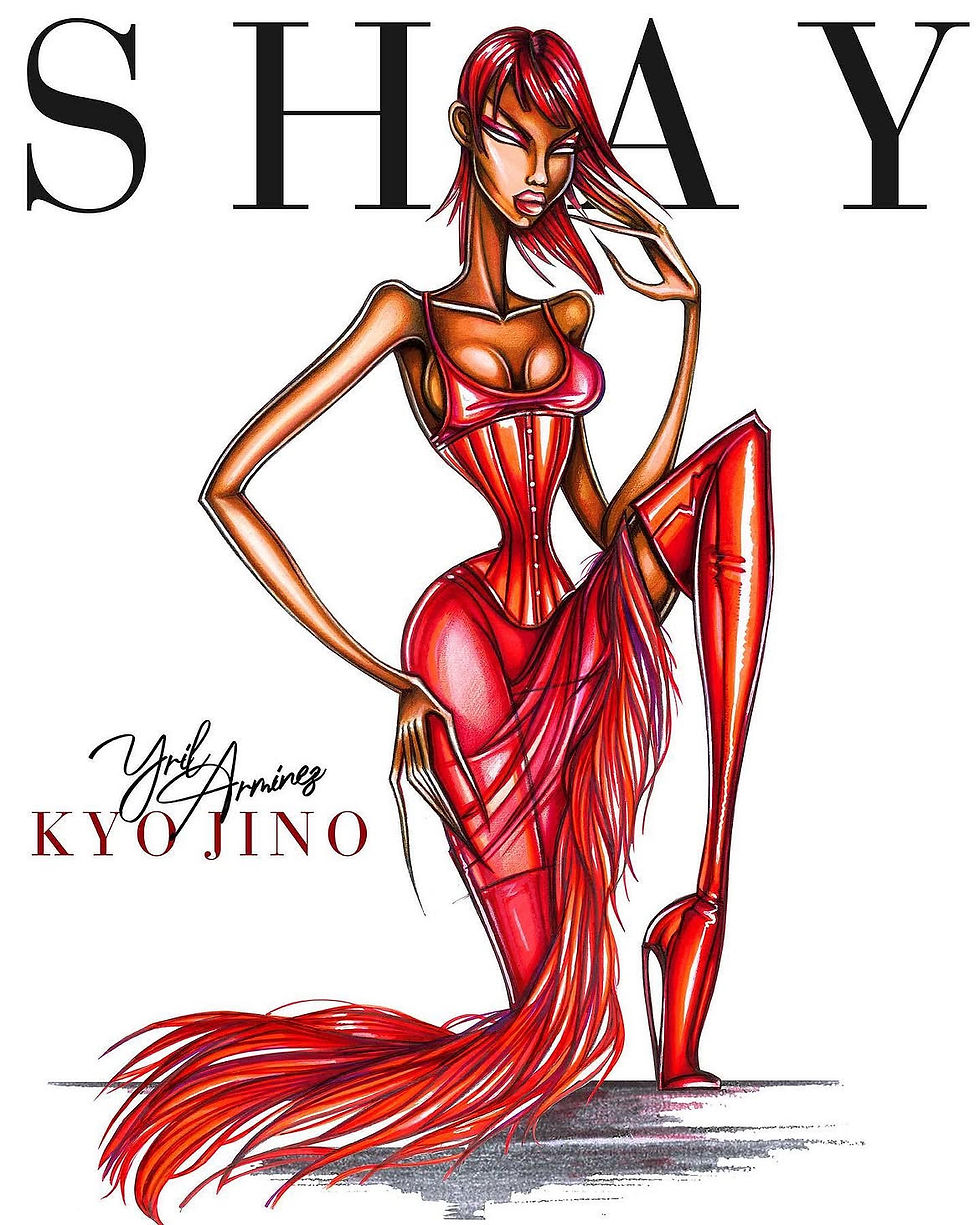
His career has since taken him across fashion, music and entertainment, with work appearing in international publications including Vogue US, i-D Magazine, Lucy Magazine and PAP Magazine. His creative collaborations have also extended into music, working with artists including Wizkid, Davido, Tyla, French Montana, Diamond Platnumz, Mohamed Ramadan, Rico Nasty, Dawn Richard and Kim Petras, alongside names from the French-speaking music scene such as Shay, Gims, Kaaris and Eva Queen.

But staying in one lane has never seemed particularly interesting to Jino. Less than two years ago, he began exploring men's streetwear, taking elements of the visual language he had developed through womenswear and translating them into a different context. It represents another stage in a career defined by experimentation rather than fixed formulas. His aesthetic can move from scarlet red and metallic silver to darker or more colourful palettes depending on the mood. That flexibility is intentional. Jino's work is not built around a single colour, silhouette or reference point, but around emotion. His images often carry a cinematic quality, with nostalgia and intensity existing side by side.
That fascination with the past extends beyond fashion because away from styling, Jino explores photography, particularly analogue photography, drawing inspiration from the visual language of the 1970s through the 1990s. Behind the camera, he finds another way to explore authenticity, nostalgia and the imperfections that give film its distinctive character.

Perhaps the most important part of Kyo's creative identity, however, has little to do with fashion itself. His work is rooted in the belief that people can become limited by the labels and expectations placed upon them. As a self-taught creative who was initially misunderstood for refusing to conform to a single aesthetic, he understands that tension personally.
Today, versatility has become one of his greatest strengths. His work moves between music videos, magazine editorials, Fashion Week, lifestyle projects, press appearances and red carpets, allowing him to constantly change environments without losing the visual identity that makes his work recognisable and for Kyo, that freedom matters. He does not see versatility as simply having multiple skills; it is the freedom to evolve without allowing a label to determine what comes next.
And perhaps that is what ultimately defines his creative journey. Beyond the clothes, artists and images, there is a message about persistence: keep experimenting, keep developing and refuse to let other people's expectations decide the limits of what you can become. If his work can give someone the confidence to recognise their own potential, then for Kyo, the purpose of creating goes far beyond the image itself.

Your work brings together African heritage, Japanese culture, anime, manga and the influence of 90s and 2000s hip-hop. What connects these seemingly different worlds for you?
What connects these different worlds the ’90s and 2000s, African culture, Japanese animation and manga, and my hip-hop influences is really the way I discovered fashion and visual storytelling when I was growing up.
I remember being a kid and absolutely loving watching MTV.
I would take inspiration from the artists and literally count how many different outfits they wore throughout their music videos. I was fascinated by the way fashion could become such a strong part of an artist’s identity and storytelling.
I found that same kind of inspiration in the manga I watched, like Bleach. I loved the uniforms and outfits of certain squads and characters. I also drew a lot of inspiration from Fullmetal Alchemist, especially the way the villains were dressed. Their silhouettes, details and overall aesthetic really stayed with me.

And when it comes to African culture, I’m deeply inspired by cultural heritage especially elements that feel powerful, meaningful and carry a strong message. I love the idea of taking something rooted in history and identity and translating it into something contemporary through fashion.
You have spoken about wanting to “give flowers” to Black women who have been overlooked in fashion. What does meaningful representation look like to you beyond simply putting a diverse face in an image?
Personally, what represents black women’s in fashion on a large spectrum to me are women who are inspiring, bold, and unafraid to make a statement with the way they dress. It’s not necessarily about having a specific body type or skin tone. It’s about being someone who has a strong presence, an undeniable aura, and confidence in who they are.
That’s what I personally see in the Black women I admire. It’s that energy, that confidence, that ability to own a room and express yourself through fashion. That’s what truly represents the Black woman to me.
Your early styling work embraced latex, PVC, vinyl and sensual silhouettes. What were you trying to communicate through those provocative looks, and how has your relationship with sensuality changed over time?
What I wanted to communicate through my work at the time, particularly through the PVC and latex aesthetic I was exploring, was my creative emancipation. I wanted to be bold and work with women who were just as bold and fearless as I was.

At that time, what I was doing was still very niche but I managed to dress celebrities in this type of look and really become mainstream in France. It was somewhat controversial, but that was actually part of what motivated me to keep pushing it further. I was drawn to that tension and to the idea of doing something that wasn’t necessarily expected or accepted yet.
What ultimately made me evolve was, first and foremost, growing as a person. I also really wanted to develop a recognizable signature something that people could immediately associate with my work. And I feel like, at that time, I really managed to create that identity and establish my own visual language.
You recently moved into men's streetwear after establishing yourself through womenswear. What made you want to enter that world, and what have you discovered about your creativity through the transition?
The transition from styling women to styling men happened very naturally. I think I had reached a point where I felt I had explored a lot of what I wanted to do with womenswear, and I wanted to challenge myself and show that I could style men as well.
At the beginning of my career, a lot of artists assumed that I couldn’t style men because they had only seen my work with women. I wanted to break that perception and show that I was capable of much more.

Today, I’ve been able to prove my versatility by working across different aesthetics from streetwear and more masculine styles for male artists to high-fashion and more fashion-forward looks for female artists.
For me, being versatile is about being able to understand the artist, their identity and their world, and translate that into a strong visual language, regardless of gender.
You were initially misunderstood because you refused to fit into one particular aesthetic. Has that experience changed the way you think about labels, versatility and creative freedom today?
It’s true that, at the beginning of my career, I was quite often labeled as the stylist who dressed Black women in a very “ratchet” and sexy way, almost as if my work was always about sexualizing them.
But what I was actually trying to bring to France was something I had already been seeing and doing in the United States ten years earlier. I was interested in bringing those aesthetics and that energy into a different context.
I’ve never wanted to stay inside the box that people tried to put me in creatively.
I know that I can do editorial and magazine work, e-commerce, personal styling for artists, styling for fashion shows, music videos I really try to explore as many different sides of my creativity as possible.
For me, versatility is essential. I don’t want to be defined by one aesthetic or one type of client. I want my work to evolve with me and to show the full range of what I’m capable of creatively.
What does your creative process look like before a shoot? Do you begin with an image, a feeling, a garment or a story?
My creative process for a photoshoot can start with absolutely anything. It could be a memory from the past that made me happy or sad, a magazine I’m looking through, a TV series, an animated show, or even something I see in everyday life while walking down the street.
I love drawing inspiration from everything around me, but also from my own personal experiences. I think the most interesting ideas often come from things that feel personal and authentic.
From there, I try to turn those references, emotions, and experiences into a story and translate that story visually through styling. For me, it’s really about taking something from my own world and transforming it into a visual narrative.
If you could go back to the beginning of your career and give yourself one piece of advice, what would it be?
If I could go back to the beginning of my career, the advice I would give myself is go even harder twice as hard, or even ten times harder and never be afraid to be creative.
Creativity will take you further and further. The more you allow yourself to experiment, take risks, and push your ideas beyond what’s expected, the more opportunities you create for yourself.
So I would simply tell myself keep going, be bold, and trust your creativity. It will take you places you never imagined.


