
Indian Textiles Taking Over Luxury Runways

Updated: Jun 20

For decades, India’s relationship with the global luxury industry was a quiet one. The embroideries on a Chanel gown, the hand-stitched beading on a couture bodice, the intricate zardozi trailing down a red-carpet silhouette; most of it was made in India, by Indian hands, and credited to nobody. The subcontinent was luxury fashion’s best-kept workshop. That era is over.
Today, Indian textiles are arriving on the world’s most prestigious runways not as background labour but as the main event. At Paris Couture Week, at New York Fashion Week, at the Met Gala, and in the most anticipated menswear shows of the season, the craft languages of India; Banarasi silk, Mukaish embroidery, Chikankari, Khadi, Zardozi, even the Kolhapuri, are being celebrated, and talked about. The shift is seismic, and it’s been building for years.
Paris Was Always the Goal. Now India Has It.
Rahul Mishra was the first Indian designer to be invited to show at Paris Haute Couture Week, and he’s been unstoppable since. Each season, he makes the case more forcefully. His Spring 2024 couture collection, “Superheroes”, was a meditation on the insect kingdom rendered in meticulous hand-embroidery: dragonflies, fireflies, and moths recreated stitch by stitch, each piece a collaboration between his design vision and the artisans of his Noida, India atelier.
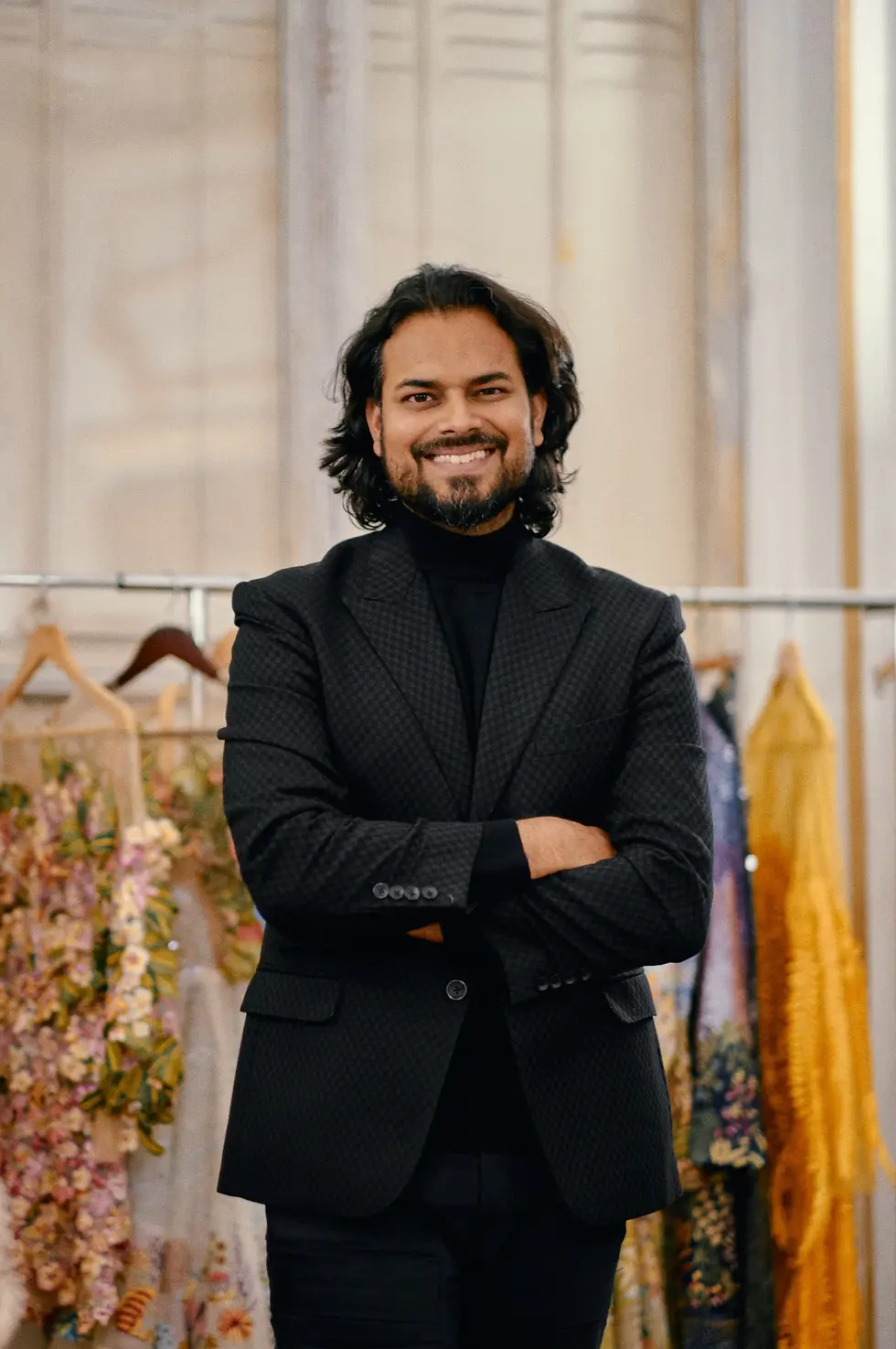
His Spring 2025 collection, “The Pale Blue Dot”, named after Carl Sagan’s famous reflection on Earth, opened with a sweeping black cape built from shimmering cuboids, its cityscape silhouette constructed from thousands of hours of handwork. The New York Times and the Financial Times covered it. Fashion, as Mishra noted with some satisfaction, rarely makes news there.
Mishra employs over 2,000 artisans directly or indirectly, many of them trained on the job in techniques that require hundreds of materials and colours in a single garment. His philosophy is explicit: couture is a medium for employment, for sustainability, for culture. The slower the process, he says, the better. It is a radical position in an industry obsessed with fast.
Gaurav Gupta joined him on the official Paris Couture schedule in 2023, becoming only the second Indian designer on that stage. His sculptural gowns, what he calls “future, primitive,” fuse architectural construction with deeply Indian spiritual references. His Spring 2024 collection, “Aarohanam”, was built around the Sanskrit concept of ascension, with serpent motifs referencing kundalini energy woven into structured, otherworldly forms. Beyoncé wore his Galaxy Crystal jacket, bodysuit, and boots to New York Fashion Week. His work now retails at leading multi-brand department stores worldwide.
The Luxury Houses Come Knocking
If Indian designers claiming space at Paris Couture was the first signal, the second, louder and more commercially charged, has been the global luxury houses turning toward India not for anonymous outsourcing, but for visible, sometimes uncredited inspiration.

In June 2025, Pharrell Williams unveiled his Louis Vuitton SS26 menswear collection outside Paris’s Centre Pompidou on a runway reimagined as a Moksha Patam board, the ancient Indian precursor to Snakes and Ladders, handcrafted in India using timber and natural pigments in collaboration with Mumbai architect Bijoy Jain. The soundtrack was composed by A.R. Rahman. The collection itself drew on turmeric yellows, sun-faded browns, and dusty pastels inspired by Indian spice markets and cityscapes, with hand-embroidered stones, lace, and micro-beading running through pieces that still felt immediately wearable. Pharrell described his visits to Indian printmaking studios and embroidery ateliers as the most meaningful part of the process. “What art and painting is to Paris”, he said, “textiles and embroidery are to India”. Vogue Runway ranked it the second most-viewed SS26 menswear show globally.

Then came Dior. When Jonathan Anderson made his debut as creative director at the Fall 2025 Couture Week, one piece stopped the fashion world: a coat reportedly priced upwards of $200,000, its surface covered in Mukaish work, a centuries-old Indian technique in which metallic thread is hand-hammered onto fabric, traditionally reserved for ceremonial dress. The craft, still practised by clusters of artisans concentrated in parts of India, had arrived on fashion’s most exclusive stage. The moment was complicated: fashion critics praised the piece’s beauty, while Indian craft advocates noted that no artisans were credited, reigniting a long-overdue conversation about transparency and attribution when global luxury borrows from living traditions.
The Fabrics Themselves Are Having a Moment
Beyond the runway credits and the designer profiles, something more fundamental is happening: the fabrics themselves are becoming culturally aspirational. Banarasi silk, with its gold and silver zari work woven in Varanasi’s ancient ateliers, is appearing in international collections that would once have turned to Italian brocade. Chikankari, the delicate shadow-work embroidery from Lucknow, has moved from the Indian ethnic wear market to the global contemporary luxury conversation. Khadi, the handspun fabric that Gandhi made the symbol of Indian self-reliance, is now a premium material for designers who prize its raw, slow-made texture.
The timing is not accidental. The global fashion industry’s reckoning with fast fashion and synthetic production has created an opening for textiles with genuine heritage, things that carry a story, a geography, a set of hands. Indian handloom traditions deliver exactly that. Sabyasachi Mukherjee, marking 25 years in fashion in 2024, has been the most vocal about the stakes. His goal, stated plainly, is for his label to become India’s first true global luxury brand, and his expansion into New York’s West Village and international retail suggests he is not bluffing.
Credit Where It’s Due
There is, running through all of this, a question that the fashion industry cannot sidestep much longer. India has always been in luxury fashion. The difference now is that it is being seen. But being seen is not the same as being credited, compensated, or treated as an equal creative partner. The Dior-Mukaish moment crystallised the tension: a $200,000 coat built on the labour of artisans who earn a fraction of that, unnamed in the show notes. The previous Dior creative director, Maria Grazia Chiuri, was praised for her transparent collaborations with Indian karigars through the Chanakya School of Craft. Anderson’s silence on the same subject felt like multiple steps backwards. Similar to Ralph Lauren appropriating the Bandhani without so much as a mention of India, let alone Indian craftsmanship.

The designers who are getting it right, Mishra, Gupta, and a generation of younger names like Kanika Goyal, Eka by Rina Singh, and Torani, are those who treat Indian craft as their own inheritance, not as raw material to be processed for a Western audience. The difference in approach produces a difference in outcome: collections that feel like genuine expressions of a design language rather than expensive costumes.
What Comes Next
India’s luxury segment is projected to grow by another 40% between 2024 and 2027, according to Bain & Company. Louis Vuitton, Dior, and Cartier are expanding their retail footprints in Mumbai, Delhi, and Bengaluru. The consumer base is growing; the cultural confidence is growing; the international recognition is, finally, growing to match.
What we are watching is not a trend. Trends have endings. This is a correction, a long- overdue reckoning with the fact that some of the most sophisticated textile traditions in human history have been operating at the margins of an industry they quietly built. The runways of Paris and New York are beginning to acknowledge what the artisans of Varanasi, Lucknow, and Kolkata always knew: Indian craft was never a footnote. It was always the whole story.


