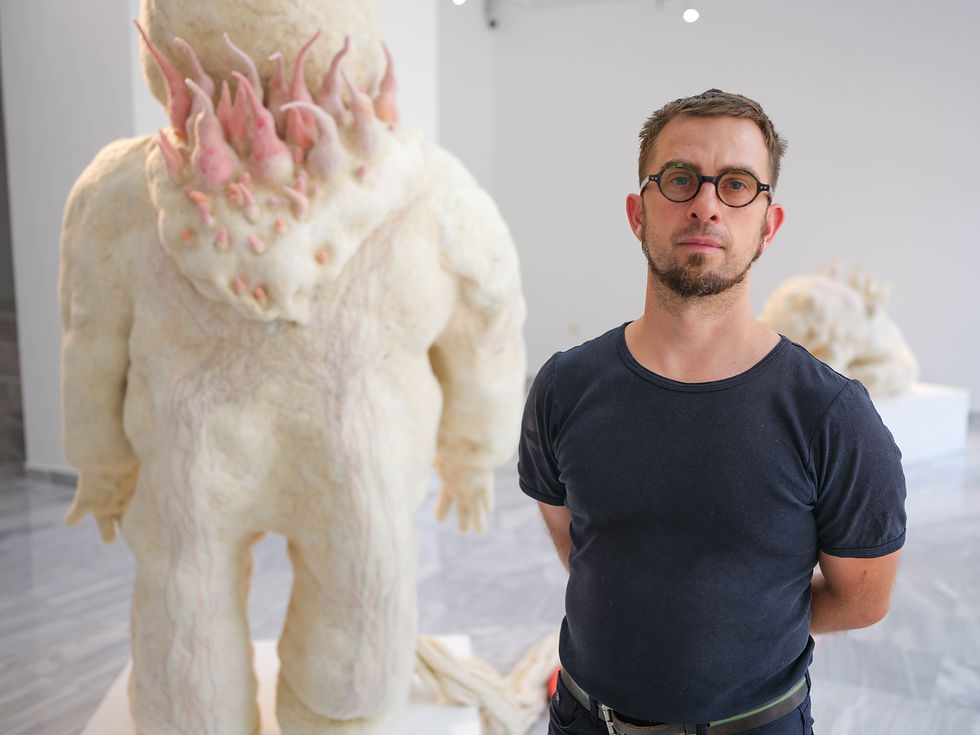
Carlos Blanco Artero Is Giving His Paintings a Physical Form


Carlos Blanco Artero’s work exists at the intersection of abstraction, figuration and sculpture, bringing together imagined characters, intricate forms and an instinctive approach to colour. The New York-based artist is now expanding his visual language beyond the canvas, exploring how the figures and shapes that inhabit his paintings can take on a life of their own in three-dimensional space.
Lately, these figures have begun to move beyond the canvas. Blanco Artero is an interdisciplinary visual artist whose practice has developed across abstraction and neo-figuration, creating a body of work defined by intricate forms, considered colour palettes and an atmosphere that can feel quietly unsettling. His paintings often bring together geometric structures and organic shapes, allowing the two to overlap in compositions that recall woven tapestries. In some works, recognisable characters emerge from these arrangements. In others, abstraction and figuration meet somewhere in between, leaving the viewer to decide what they are looking at.
His use of colour is equally distinctive. Softer tones sit alongside deeper, more saturated shades, giving the paintings a sense of depth without making them feel overly polished or predictable. Some are created on linen, introducing another material dimension to the work. Through his study of materials and the ways they interact, Blanco Artero builds surfaces that reward a closer look.
Oil painting is central to his practice, particularly the alla prima technique, in which paint is applied directly, often in a single session while it is still wet. In Blanco Artero’s hands, this approach contributes to passages of sharp focus and blur, creating an unusual sense of perspective. Figures can appear fragmented or disconnected from their surroundings, as though they belong to a different visual logic from the world around them. The result is a kind of neo-figurative space that feels familiar at first glance but becomes harder to define the longer you spend with it. Now, sculpture is becoming an increasingly important part of that world.

For Blanco Artero, painting and sculpture are not separate practices competing for attention. They are connected ways of exploring the same ideas. A figure that begins as an image on canvas can become something with volume, weight and a physical presence in the room. What was once contained within a painted surface now occupies the viewer’s space, changing the relationship between the artwork and the person standing in front of it.
He imagines exhibitions as environments in which paintings and sculptures exist together, each affecting how the other is understood. A sculpture might feel like a character that has stepped out of a painting, while the painting itself becomes a kind of point of origin. The transition between two-dimensional imagery and three-dimensional form is becoming a central part of his artistic direction.
It is an exciting development because it gives Blanco Artero’s already distinctive visual language another way to unfold. The figures, shapes and imagined spaces that have lived within his paintings can now be encountered from different angles and at different distances. Sculpture introduces a new physical relationship with these forms, allowing the viewer to experience them beyond the boundaries of a frame.
Blanco Artero’s career has already taken his work into several significant cultural settings. He has held solo exhibitions at the European Museum of Modern Art (MEAM) in Barcelona and the Centro de Historia Museum in Saragossa. His projects have also included Rethinking Guernica at the Museo Nacional Centro de Arte Reina Sofía in Madrid, as well as Personal Structures, presented by the European Cultural Centre during the 59th Venice Biennale. He was named a finalist in the international open call for the XIII Florence Biennale, and his work is held in public collections including MEAM and the Spanish Benevolent Society in New York. His practice was also featured in the 2025 publication Blanco, published by By Publications.

What makes this next chapter worth following is the way it builds on what is already present in his work. Blanco Artero’s paintings have long suggested figures and forms that seem to exist just beyond our ability to fully understand them. By bringing sculpture into the conversation, he gives those forms another kind of life.
The canvas is no longer necessarily where the image ends. It can be where something begins.