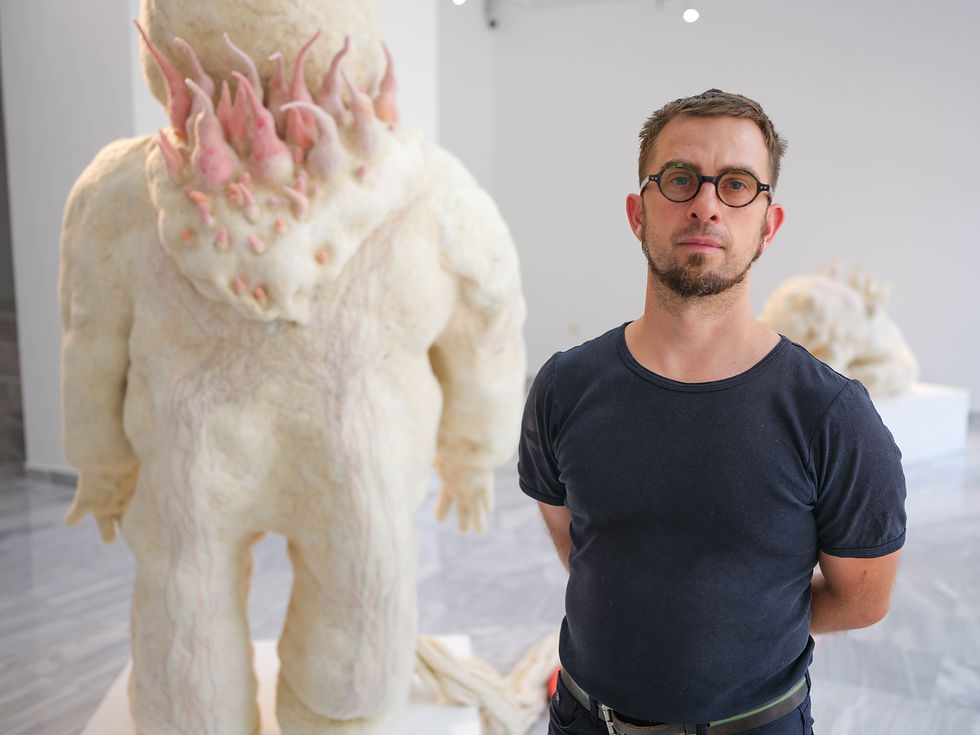
Æmen Ededéen Is Exploring the Space Between Dreams and Art


What happens when a library becomes a tool for divination, a painting becomes a record of the unconscious, and the act of making art begins to resemble a game? For abstract artist Æmen Ededéen, these ideas come together through an evolving practice that brings literature, philosophy, painting and personal interpretation into the same conversation.
Born in a small American military town and now based in New Mexico, Ededéen approaches painting as a process of discovery. His work often develops through multiple layers, with earlier images partially concealed beneath later ones. What remains on the surface is only part of the story, leaving room for unexpected forms, fragments and associations to emerge. For the artist, painting is less about arriving at a fixed image than gradually uncovering something that was already there. That interest in what lies beneath the surface extends into The Glass Dream Game, a divination system Ededéen developed in 2024 and now practises daily. The project brings together his interests in Taoist philosophy, Jungian dream analysis and the unexpected connections that can emerge between texts. It also introduces an unusual element into his work: chance.
The starting point was Hermann Hesse’s 1943 Nobel Prize-winning novel The Glass Bead Game, a book concerned with the relationships between intellectual disciplines, culture and systems of knowledge. Ededéen found a point of departure in Hesse’s ideas, but the underlying structure of his own game draws from the ancient Chinese divination system known as the I Ching, or The Book of Changes. The process begins in his private library of approximately 1,000 books. Six are selected at random, followed by one randomly chosen page from each. Together, the six pages form what Ededéen calls a Hexagram, a starting point for a process of reading, observation and interpretation.
From these pages, he takes notes and makes sketches, paying attention to recurring images, unexpected connections and synchronicities between otherwise unrelated passages. Each session is known as a Trial. The material gathered during a Trial is then developed into a Dream in Movements, a written composition that connects the different elements brought together by the Hexagram. From there comes the Vision, which takes the form of a painting or an object. The final work is not intended to illustrate the written Dream directly. Instead, it emerges through a more indirect process, informed by the ideas, associations and impressions that have surfaced along the way.
Over time, the Trials, Dreams, Visions and Hexagrams begin to form an expanding network of relationships. A passage from one book might unexpectedly echo an image in another, while an idea encountered by chance can take on a personal significance that only becomes apparent later. Ededéen approaches these moments through his interest in the unconscious, treating the library as an active participant in a continuing exchange between texts, images and memory.
The project also offers a different way of understanding how his paintings come into being. Ededéen has described his approach to painting as an iterative process in which several different paintings can exist beneath the final surface. He builds up his compositions using temporary substrates that adhere to different areas of the work without permanently binding to them. As new layers are introduced, earlier imagery can remain visible in fragments or disappear almost entirely.
The result can appear abstract to one viewer while revealing recognisable forms or suggestive imagery to another. Different people may find themselves drawn to entirely different passages within the same painting, bringing their own memories and associations to the encounter. Meaning is allowed to remain open, shifting according to what each person brings to the work.

This is where The Glass Dream Game and Ededéen’s painting practice meet most clearly. Both rely on a willingness to work without knowing exactly where the process will lead. Chance introduces the initial material, but attention, interpretation and repeated engagement shape what follows. The finished work becomes a record of that journey, carrying traces of decisions, discoveries and connections that may not be immediately visible.
Ededéen’s website extends this process beyond the finished artworks, documenting the dates, source texts, notes, sketches, archetypes and other material associated with the Trials and Visions. The archive allows viewers to follow the development of the game and explore the relationships that emerge between its different stages. Rather than presenting each painting as an isolated object, it reveals the wider network of ideas and experiences from which the work develops.
His practice is also finding an audience through exhibitions. His work is currently being presented in Dallas, Texas, alongside other gallery appearances. At The Armory Show in New York, it is on view through Maruani Mercier at Booth 105. On 7 November 2026, Ededéen is scheduled to present his next show in Los Angeles, titled The Key to the Book on the Shelf in the Library, with The Glass Dream Game at the centre of the project.
The game occupies an interesting space between contemporary art and systems of play. Although it follows a set of procedures, its outcomes are not predetermined. Every Trial produces a different combination of texts, and each combination creates new possibilities for interpretation. Its structure encourages repetition while allowing the results to remain unpredictable, making the process itself as important as the work it produces.

For Ededéen, painting is connected to the possibility of awakening, and to a larger contemplative or devotional practice. His work invites viewers to spend time with uncertainty, to notice relationships they might otherwise overlook and to consider how meaning can develop through sustained attention. In a culture that often rewards immediate answers and easily explained images, The Glass Dream Game takes another route. It begins with books selected by chance and follows the connections that emerge from them, moving through writing, drawing and painting without insisting on a single conclusion.
What ultimately remains is an ongoing conversation between the artist, his library and the unconscious. Each painting becomes another stage in that exchange, holding fragments of what came before while leaving space for something not yet understood to emerge.