Arpad Pulai Looks to Tradition for a More Sustainable Future

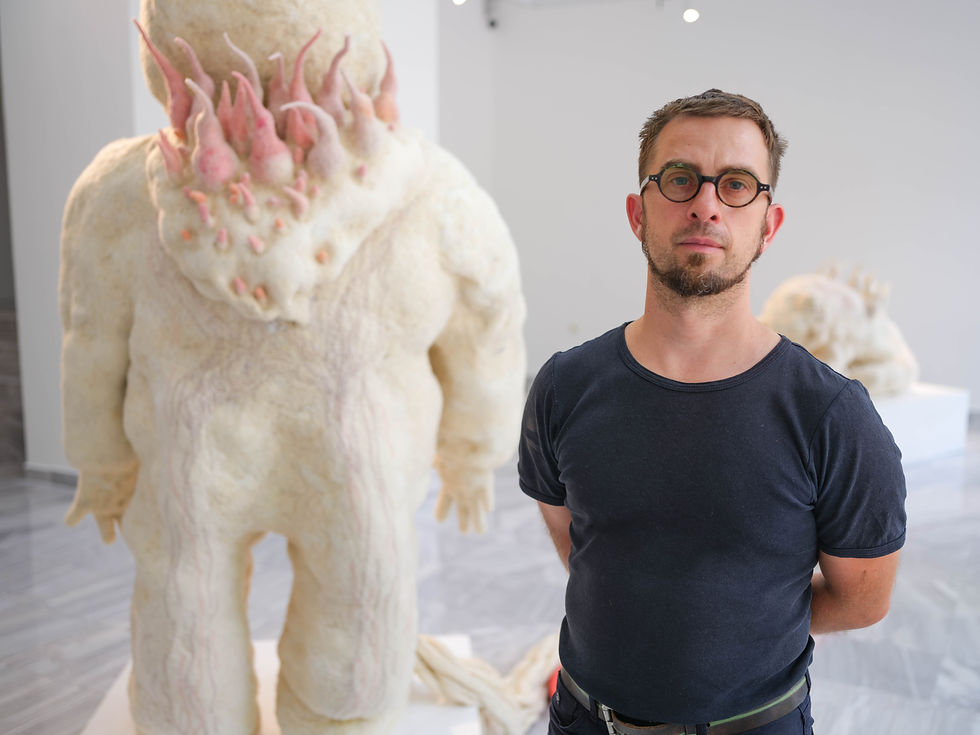
Arpad Pulai’s work begins with textiles, but it rarely ends there. For the Serbian artist and textile designer, fabric becomes a way of looking at society, tradition, sustainability and the relationship between making and the materials we choose to live with.
Pulai graduated from the Faculty of Applied Arts in Belgrade in 2012, specialising in Textile Design, and returned to the same institution in 2019 to begin his doctoral studies. His connection to teaching has remained an important part of his practice. Between 2014 and 2015, he taught Textile Design at the Bogdan Šuput School of Design in Novi Sad. Since 2015, he has worked at the Textile Department of the Faculty of Applied Arts in Belgrade, where he became a Senior Artistic Associate in 2022.
Alongside his academic work, Pulai has developed a practice that moves between textile design and art. He also works in costume breakdown for film production, adding another dimension to his understanding of clothing, materials and the visual language of textiles.
Sustainability is central to much of his artistic work. Pulai is interested in what can happen when ecological and natural materials are brought into the creative process, as well as what happens to materials that might otherwise be discarded. Recycling becomes more than a practical solution. In his work, it can become part of the concept itself, opening up questions around consumption, production and the value we place on handmade objects.
There is also a strong connection to textile traditions in Pulai’s work. In 2014, he founded the citizens' association Čunak in Srbobran, an organisation dedicated to keeping textile-making practices active through weaving, knitting and workshops. Čunak works with both horizontal and vertical looms and offers training in hand and machine knitting, while its art and textile workshops create opportunities for people to engage directly with the processes behind textile production.
That hands-on approach is significant in an industry increasingly shaped by mass production. Weaving, knitting and other forms of textile craft require time and attention. They also carry knowledge from one generation to another, something Pulai's work continues to explore through both his own practice and his teaching.

His involvement in the wider design community has grown alongside his work. Pulai has been a member of ULUPUDS, the Association of Applied Artists and Designers of Serbia, since 2013 and joined the European Textile Network in 2017. His work is now held in the collections of Atelier 61 in Novi Sad, the Gallery of Contemporary Fine Arts in Niš and the Museum of Applied Art in Belgrade.
His practice has also reached an international audience. His work was featured in the German magazine Bauwelt in 2022 and later appeared in the British magazine Cover in 2025.
For Pulai, textiles exist somewhere between art, design and everyday life. They can carry history, reflect social questions and offer a more considered approach to the materials around us. Through weaving, recycling, natural materials and education, his work keeps the traditional knowledge of textile-making in conversation with the questions facing contemporary design.