

Interview: Eloise Harcourt
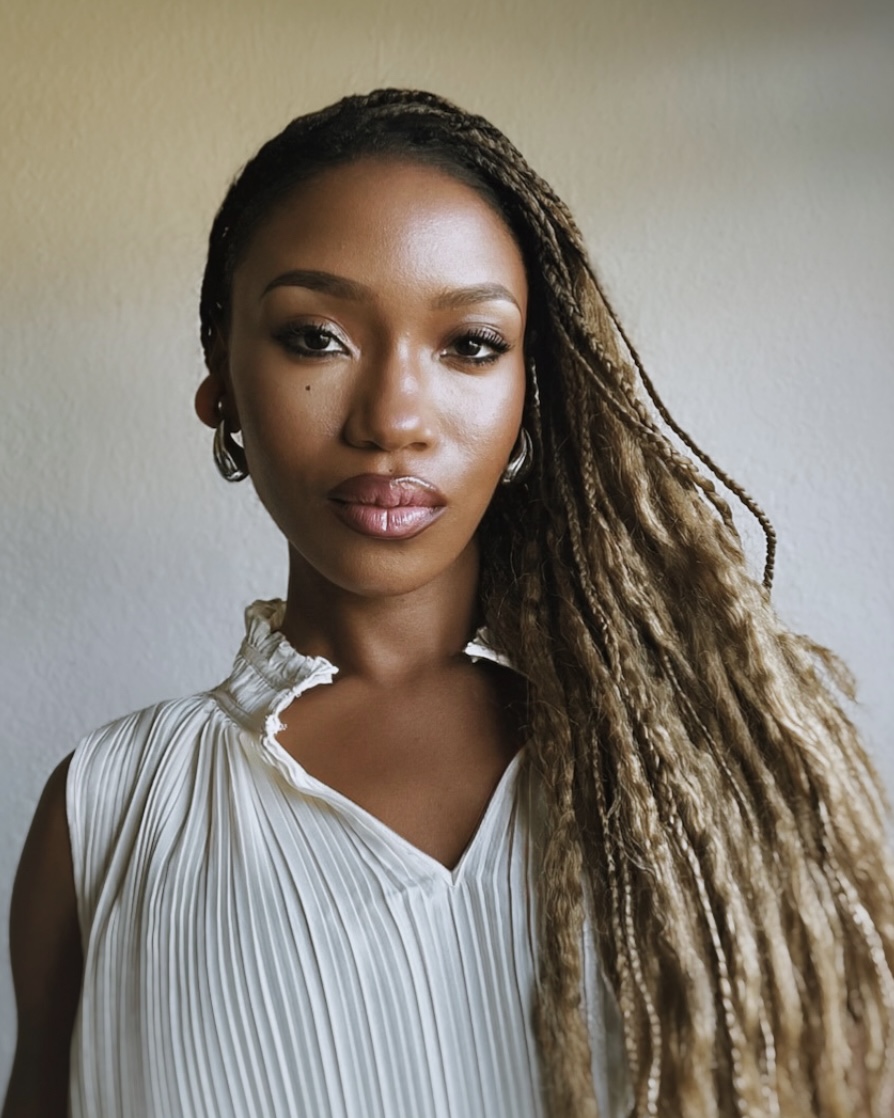

Eloise Harcourt explores the body, how we experience it, and how it is shaped by history and society. In this interview, she shares more about her creative process, the ideas behind her work, and what draws her to exploring the body through different materials and forms.
1. You use fabricated forms to explore the body beyond traditional representations of the human figure. What would you say your depictions communicate about the body that a more literal depiction might not?
My sculptures capture the essence of the somatic experience. They communicate visceral, three-dimensional feelings that are difficult to articulate through language. That's why I make sculpture. I believe that where language reaches its limits, art expands the possibilities of communicating something intangible.
By abstracting the human form into a suggestion rather than a literal representation, I engage the viewer's instinct to recognize humanity in the world around them. There's a psychological phenomenon called pareidolia, which describes our tendency to perceive familiar patterns, particularly faces, in unrelated objects. Think of seeing a face in a light switch or a figure in the folds of a curtain. Our brains are wired to search for recognizable forms, and I'm fascinated by how little visual information we need to perceive something as human.
My pieces play with this instinct, as well as our tendency to personify inanimate objects. A fold of fabric, a tuft of hair, or a fleshy protrusion can give an object an uncanny sense of life. I'm also interested in the emotional attachments we form with everyday objects and the ways they accumulate meaning through use, memory, and physical contact. By leaving the human figure ambiguous, I invite viewers to project their own associations and bodily experiences onto the work. Rather than prescribing what a body should look like, I want to create an encounter that makes viewers conscious of their own physical existence.
2. In works like Alter, Tender Series, and Beheld, the forms appear kneaded and secured into place, almost like working with dough. There’s something visually satisfying about the way these materials are manipulated. What does this physical process feel like for you, and is there a sense of satisfaction or release in shaping the materials this way?
The physicality of making is one of my favorite parts of being a sculptor. There's a childlike satisfaction in manipulating materials with my hands. I love the process of transforming something ordinary into a form that feels alive.
I'm particularly interested in the relationship between my body and the material. Making becomes a physical negotiation between the two. I apply pressure, the material resists, and the resulting forms bear the evidence of that interaction. Every fold, indentation, and stretched surface becomes a record of touch. But this exchange goes both ways. My body hurts differently depending on what I'm making. I develop specific calluses and aches from the repetitive motions each piece demands. Just as I leave my imprint on the sculpture, the process leaves its own marks on me.
There's also a sense of freedom in allowing the materials to behave unpredictably. I don't want everything to be perfectly controlled or resolved. Some of my favorite moments happen when a material does something I didn't anticipate, and I have to respond to it rather than impose my original intentions. I think that spontaneity is part of what gives the finished objects their sense of life.

3. Your work often brings together opposing qualities, such as softness and rigidity, beauty and discomfort. What gravitates you toward these contrasts, and how do they shape the direction of a piece?
I love contradiction and the mindfuck of trying to hold multiple contradictory truths at once. Something can be beautiful and repulsive, comforting and threatening, delicate and grotesque. I think the human body embodies these contradictions perfectly. It's capable of extraordinary strength and profound vulnerability, pleasure and pain, creation and destruction.
I'm fascinated by the discomfort we experience when something defies the categories we've been conditioned to see as natural. Our perceptions of beauty, gender, and even morality are shaped by social conventions that we internalize and reproduce, often mistaking them for objective truths. I'm interested in what happens when those distinctions break down and we're forced to question not only our assumptions, but where they came from and whose interests they serve.
I approach making with that same curiosity. Sometimes I'll introduce an object or material that seems completely incompatible with what I'm working on, just to see what happens. I like when a piece surprises me or starts to undermine my original intentions. There's a particular satisfaction in making something that I can't quite decide whether I love or hate. If I can provoke that same confusion in someone else, I'm happy.
4. In your photography, Skinscapes: Body as Site and (Con)formation, you focus on the skin’s folds, shifts, and responses. What draws you to these intimate details of the body that are often overlooked?
I'm fascinated by how quickly the body becomes unrecognizable when you change the way you look at it. A fold of skin becomes a mountain range, a desert landscape, an architectural form. The body remains present in these images, but becomes something evocative rather than representational. In Skinscapes, I use my own body to create abstract compositions that challenge the viewer's ability to distinguish between the familiar and the foreign. There's something exciting about making the most intimate and recognizable thing we possess feel completely alien.
I'm also interested in the politics of looking closely. We're taught to scrutinize our bodies, particularly as women, but that scrutiny is almost always directed toward identifying and correcting perceived imperfections. I'm interested in reclaiming that attention as an act of curiosity rather than criticism. What happens when we examine a wrinkle, a crease, or a distortion without immediately assigning it aesthetic or moral value?

5. How did your experience as an EMT shape the way you understand the body, and does it further influence the questions you now explore through your art?
Working as an EMT fundamentally changed the way I understand the body. For four years, I had the privilege of showing up for people at moments of extreme vulnerability, witnessing both the extraordinary resilience of the human body and the people who inhabit it, and the frightening ease with which those bodies and people can be failed. I developed a deep respect for the biological intricacies of our existence, but also a heightened awareness of how much of our bodily experience lies beyond our control.
What affected me most was the Sisyphean task of trying to fill the gaping holes left by systems that routinely fail the very people they claim to care for. As an emergency medical provider, your responsibility is to triage, stabilize, and address the immediate crisis. You rarely find out what happens to your patients afterward. Yet many of the emergencies we respond to are not isolated incidents but predictable consequences of systemic neglect: barriers to healthcare, housing instability, inadequate mental health services, and the erosion of social safety nets. You can stabilize a patient, but you cannot stabilize the conditions of their life.
I became increasingly frustrated by a system that is often better equipped to manage the consequences of suffering than to address its causes. In order to regulate the body through policy, institutions must first flatten it into something legible, measurable, and classifiable. But people are not isolated medical events, and their health cannot be separated from the social, political, and economic conditions of their lives. There's a profound difference between treating a body and creating the conditions in which a person can actually thrive.
My experience as an EMT made me question how systems intended to care for people can also limit their autonomy, reduce them to statistics, and overlook the circumstances that shape their lives. Those contradictions are central to my art. I'm concerned with what gets lost when human experience is translated into institutional categories, and I use my art to resist that reduction, creating bodies that refuse to be neatly classified or contained.
6. Given your interest in how the body is defined and categorized, how do you approach making work that challenges conventional ideas of what the body should look like or represent?
I think it's absurd how much energy we devote to making our bodies conform to arbitrary standards, particularly when those standards are constantly changing. We're taught to regard the body as a project that requires perpetual improvement. I'm interested in rejecting the premise that a body needs to be aesthetically pleasing, productive, or even comprehensible to deserve respect.
My sculptures are unapologetically excessive. I'm drawn to forms that feel simultaneously familiar and impossible to identify, because they interrupt our instinct to immediately classify what we're looking at. I want the viewer to encounter the body without the usual framework of expectations that tells us how to interpret it.
Humor is also a huge part of my approach. I don't think challenging deeply ingrained ideas about the body needs to be solemn or didactic. There's something wonderfully subversive about making an object that's ridiculous, grotesque, and strangely endearing all at once. I want my sculptures to have a sense of personality, even agency, as though they're entirely indifferent to whether anyone finds them beautiful or appropriate. There's a freedom in imagining bodies that exist so unapologetically, especially when I find myself yearning to escape the pressures imposed on my own.

7. Your work places soft, flesh-like forms against rigid structures. How do you explore the idea that something designed to protect the body can also restrict it?
Protection can easily become confinement, and the distinction often comes down to who is in control. A structure designed to provide safety can also dictate how a body is allowed to move, behave, or exist within it. I think about this in relation to everything from domestic furniture to medical equipment and institutional systems. A bed can be a place of rest, intimacy, illness, or captivity. The object itself doesn't change, but its meaning shifts dramatically depending on the circumstances and the autonomy of the person occupying it.
In my sculptures, I'm interested in making these power dynamics physical. Soft forms press against rigid frames, swell through openings, or appear to strain against the structures holding them. In Alter, a bed frame becomes inseparable from the flesh-like forms inhabiting it. It's difficult to tell whether the structure is supporting the body or restraining it, whether the body is being protected or struggling to escape.
I'm interested in reversing the power dynamic. What happens when the object designed to contain a body begins to behave like a body itself? By giving these objects an unruly physical presence of their own, I can disrupt their familiar functions and question the weight, both literal and metaphorical, that we assign to them.
8. Your research explores medical histories and the ways bodies are defined and categorized. What have you discovered through the process of making that you couldn't have understood through research alone?
I think there's a fundamental difference between understanding the body intellectually and understanding it through physical experience. I can spend hours researching medical histories, anatomical systems, and the politics of bodily autonomy, but that knowledge exists at a certain distance from the body itself. Making sculpture collapses that distance. It requires me to engage with weight, resistance, gravity, and the limits of my own physical capabilities. The body becomes both the subject of my inquiry and the instrument through which I conduct it.
What I've learned through making is that control is an illusion. I can approach a sculpture with a clear intention, but materials have their own properties and limitations. I have to negotiate with them rather than simply impose my will. There's an interesting parallel between that process and the ways we attempt to understand and regulate our own bodies. No matter how precisely we study or categorize them, they remain unpredictable, constantly changing, and ultimately beyond our complete control.
I also think making has taught me to trust forms of knowledge that can't necessarily be articulated. There's an intelligence in touch, intuition, and physical repetition that isn't easily translated into language. Sometimes I understand something through the physical act of making long before I can explain it. That's part of what draws me to sculpture in the first place: it allows me to investigate questions that don't necessarily have answers, or even words to describe them.


